
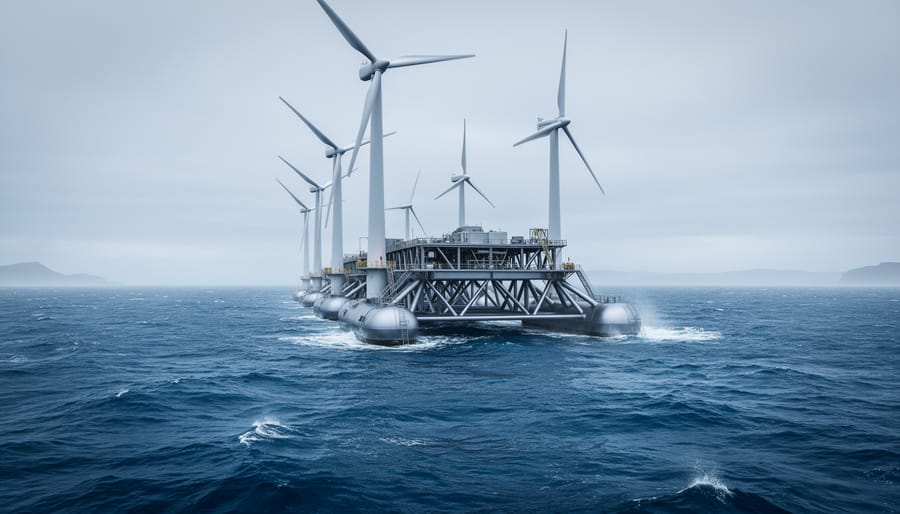
A renewable energy plant in the ocean is an offshore installation that converts marine resources into electricity, primarily through wind turbines mounted on floating or fixed platforms, though wave, tidal, and thermal technologies also operate in coastal and deep-water environments. These facilities harness the persistent, high-speed winds found at sea and the kinetic energy of ocean currents to generate power at scales that rival conventional energy infrastructure, often without the land-use constraints that limit onshore renewables.
The ocean covers more than 70 percent of Earth’s surface, and its energy potential remains largely untapped. Offshore wind alone could theoretically supply multiple times the global electricity demand, while tidal and wave systems offer predictable generation patterns that complement the variable output of solar and wind farms on land. As climate targets tighten and grid operators seek stable, low-carbon baseload capacity, marine energy installations are transitioning from pilot projects to commercial deployments.
Atlantic Canada exemplifies this shift. In 2026, Nova Scotia’s offshore energy regulator qualified seven bidders for the province’s first five-gigawatt seabed leasing round, with a formal call for bids expected later this year. The Canada-Nova Scotia Offshore Energy Regulator completed its review process between October 2025 and January 2026, and Hydro-Québec has requested information on transmitting electricity from future offshore wind farms in the region. While one developer estimates turbine commissioning around 2035, the regulatory momentum signals a long-term commitment to ocean-based generation.
This article defines what renewable energy plants in the ocean are, explains how they capture and convert marine energy, categorizes the technologies in operation today, and examines real-world applications driving the sector forward.
What Ocean-Based Renewable Energy Means
Ocean-based renewable energy refers to electricity generation infrastructure installed in marine environments to capture naturally occurring forces, wind, waves, tidal currents, and thermal gradients, and convert them into usable power. Unlike land-based renewable installations, these plants leverage the ocean’s consistent, high-energy conditions: stronger and steadier winds over water, predictable tidal cycles governed by lunar patterns, and the continuous motion of waves across vast expanses. The fundamental principle remains the same across all ocean energy technologies, intercepting kinetic or thermal energy in motion and transforming it through mechanical or thermodynamic processes into electrical current.
What qualifies as an ocean renewable energy plant depends on both location and energy source. The installation must sit in marine waters (coastal zones, continental shelves, or deep ocean areas) and harness one of four primary ocean resources: wind moving across the sea surface, wave motion generated by that wind, tidal flows driven by gravitational forces, or temperature differences between surface and deep waters. Atlantic Canada’s five-gigawatt offshore wind initiative demonstrates how these projects take shape in practice, with companies now qualified to bid on seabed licences for turbine installations in Nova Scotia’s coastal waters.
- Offshore Wind
- Electricity generation using turbines mounted on fixed or floating foundations in ocean waters, typically installed beyond visual range of coastlines where winds blow stronger and more consistently than onshore.
- Wave Energy
- Power captured from the oscillating motion of ocean surface waves using devices that convert vertical or horizontal wave movement into mechanical energy.
- Tidal Energy
- Electricity produced by harnessing the kinetic energy of predictable tidal currents flowing between high and low tide cycles, usually through underwater turbines similar to submerged wind turbines.
- Ocean Thermal Energy Conversion (OTEC)
- A process that exploits temperature differences between warm surface waters and cold deep ocean layers to drive heat engines and generate power.
- Seabed Leasing
- Regulatory agreements granting companies rights to specific ocean floor areas for renewable energy installations, typically awarded through competitive bidding processes managed by government authorities.
Ocean locations offer distinct advantages that explain the growing investment in marine energy plants. Water surfaces experience less turbulence and friction than land terrain, producing more uniform wind speeds and reducing wear on turbine components. Coastal populations, where electricity demand concentrates, sit adjacent to vast marine territories, shortening transmission distances compared to remote desert solar arrays or mountain wind farms. The ocean’s sheer scale provides space for large installations without competing land uses, while tidal and wave patterns deliver energy on schedules that can complement solar and land-based wind generation.
How Ocean Renewable Energy Plants Work
Energy Capture and Conversion
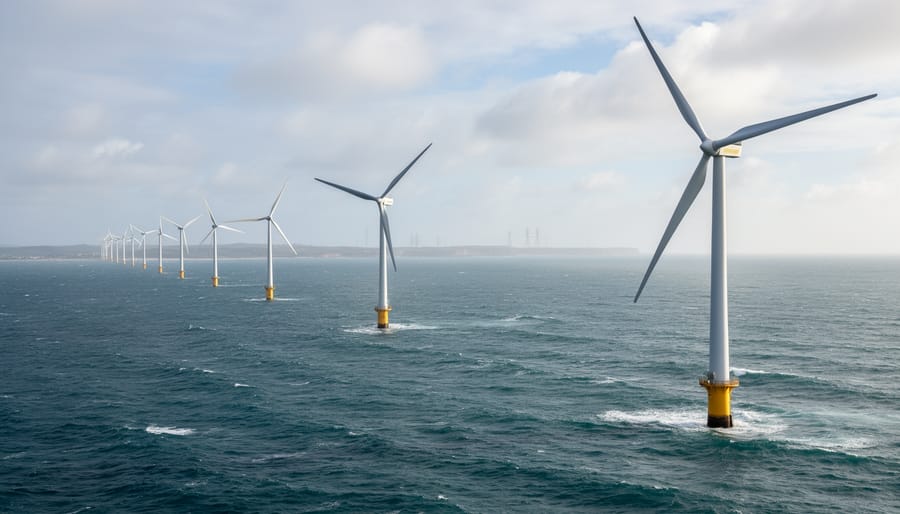
Ocean renewable energy plants transform natural forces into usable electricity through a multi-stage conversion process. In offshore wind installations, the most mature ocean energy technology, turbine blades capture kinetic energy from moving air. Wind pushes against the aerodynamically designed blades, causing them to rotate around a central hub. This rotation drives a shaft connected to a gearbox that increases the rotational speed before it reaches a generator housed inside the turbine nacelle.
Inside the generator, electromagnetic induction converts mechanical rotation into alternating current electricity. Copper coils spin within a magnetic field, producing electrical voltage that flows through internal cables. The electricity typically exits at medium voltage (around 33 kilovolts) and travels down through the turbine tower to a transformer at the base or on an offshore substation platform.
Wave energy converters follow similar principles but capture motion from ocean swells rather than wind. Point absorber buoys, for example, rise and fall with wave action, driving hydraulic pistons or linear generators that convert the vertical movement into electricity. Tidal turbines operate like underwater wind turbines, with rotor blades turned by tidal currents instead of air. Ocean thermal energy conversion systems use a different approach entirely, circulating a working fluid through heat exchangers that exploit temperature gradients between warm surface water and cold deep water to drive turbines.
Transmission and Grid Integration
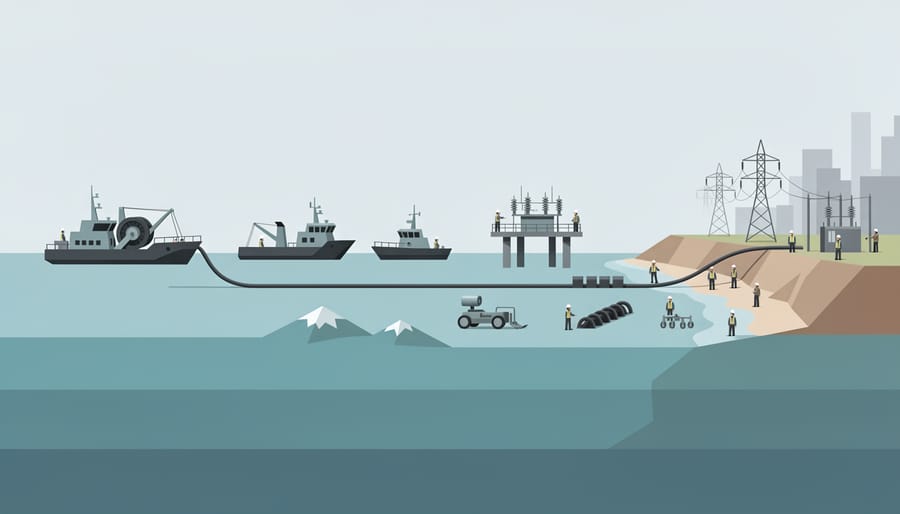
Moving electricity from ocean-based installations to consumers requires specialized infrastructure that can withstand marine conditions while maintaining grid reliability. Export cables buried in the seabed carry high-voltage electricity from offshore platforms to onshore substations, where transformers adjust voltage levels for compatibility with existing transmission networks. The distances involved, often twenty to one hundred kilometers or more, demand careful engineering to minimize energy losses and protect cables from ship anchors, fishing gear, and seabed movement.
Onshore, grid operators must balance the variable output from ocean energy plants with demand patterns and other generation sources. Advanced forecasting systems predict wind speeds, wave heights, or tidal cycles to anticipate power availability hours or days ahead, allowing utilities to schedule complementary generation or storage. Regions pursuing large-scale ocean energy deployment, such as Atlantic Canada with its five-gigawatt offshore wind seabed leasing initiative, face particularly complex integration challenges. Hydro-Québec’s 2026 request for information on electricity transmission infrastructure for future Atlantic Canadian offshore wind farms reflects the scale of planning required to connect remote ocean installations to population centers and industrial loads across provinces.
Types of Ocean Renewable Energy Technologies
Offshore Wind Farms
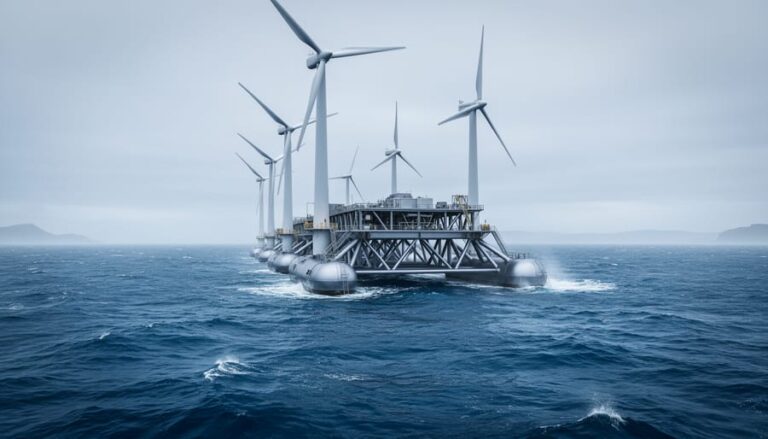
Offshore wind farms represent the most mature and commercially viable ocean renewable energy technology deployed in marine environments today. These installations use large wind turbines mounted on structures anchored to the seabed or floating platforms to capture the stronger, more consistent winds available over open water. Fixed-bottom turbines dominate current deployments, with their foundations driven into the seafloor in waters typically less than sixty meters deep, while floating configurations, tethered to the seabed with mooring lines, enable energy generation in deeper offshore zones previously inaccessible to wind development.
The technology’s advancement toward grid-scale deployment is well-documented in IEA Wind commercialization status reports tracking offshore wind’s transition from demonstration projects to multi-gigawatt developments. Atlantic Canada exemplifies this progression: Nova Scotia is pushing ahead with its first five-gigawatt seabed leasing, with the Canada-Nova Scotia Offshore Energy Regulator having qualified seven bidders, five companies and two groups, through a review process between October 2025 and January 2026. A formal call for bids will be issued later in 2026, with Q Energy France projecting commissioning of offshore turbines by 2035.
Wave Energy Converters
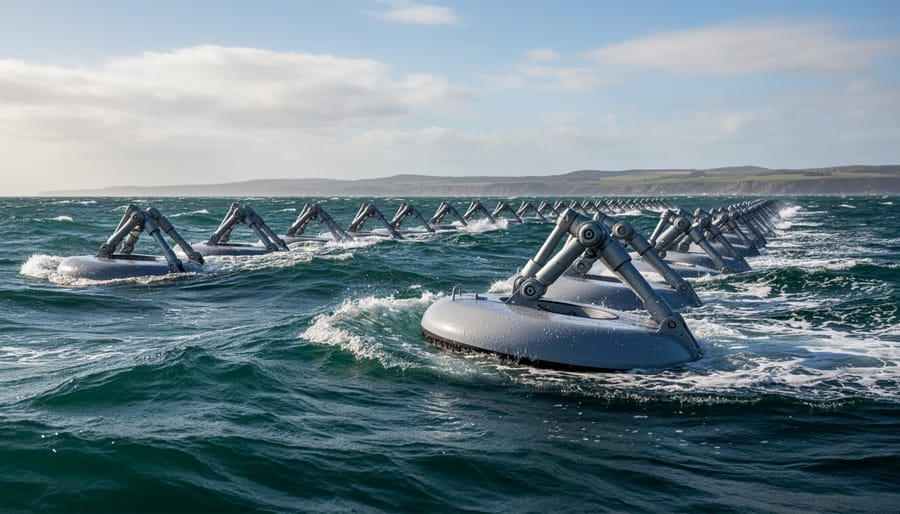
Wave energy converters represent one of the more experimental branches of ocean renewable infrastructure. These devices extract power from the constant motion of surface waves using three primary configurations. Point absorbers are buoy-like structures that float on the surface and convert the up-and-down motion of waves into mechanical energy through hydraulic pumps or linear generators. Oscillating water columns use air compression, waves force water into a chamber, pushing air through a turbine as water levels rise and fall. Attenuators are long, segmented floating structures aligned with wave direction; as waves pass along their length, the segments flex at joints, driving hydraulic systems that generate electricity. While offshore wind farms now connect to infrastructure like a virtual power plant wave converters remain largely in pilot and demonstration phases, with no commercial-scale deployments comparable to the five-gigawatt offshore wind developments planned for Atlantic Canada as of 2026.
Tidal Energy Systems
Tidal energy systems operate on the fundamental predictability of tidal cycles, converting the kinetic energy of moving water into electricity through underwater turbines positioned in areas with strong tidal currents. Unlike the variable nature of wind or waves, tides follow reliable patterns determined by lunar and solar gravitational forces, allowing operators to forecast energy generation with exceptional accuracy. The most common configuration deploys horizontal-axis turbines, resembling submerged wind turbines, anchored to the seabed in channels where tidal flows accelerate naturally, such as narrow straits or estuaries. An alternative approach uses tidal barrages, which function like low dams across tidal basins, channeling water through turbines as the tide rises and falls. While tidal energy remains less commercially advanced than offshore wind as of 2026, pilot installations in locations like Scotland’s Pentland Firth and Canada’s Bay of Fundy have demonstrated the technology’s viability in regions with sufficient tidal range and flow velocity.
Ocean Thermal Energy Conversion
Ocean thermal energy conversion (OTEC) systems generate electricity by exploiting the temperature differential between warm surface waters and cold deep ocean layers, typically requiring at least a 20°C difference to operate efficiently. A working fluid with a low boiling point, such as ammonia, vaporizes when exposed to warm surface water, driving a turbine to produce electricity. The vapor then condenses against pipes carrying cold water pumped from ocean depths of 800 to 1,000 meters, completing the thermodynamic cycle.
OTEC plants function continuously regardless of time or weather conditions, offering baseload power generation potential in tropical and subtropical regions where temperature gradients remain stable year-round. Despite this theoretical advantage, the technology remains largely experimental as of 2026, with only demonstration-scale installations operating worldwide. High capital costs for deep-water pipelines, complex marine construction requirements, and low thermal efficiency compared to other ocean energy technologies have prevented commercial deployment at the scale seen in offshore wind development.
Where Ocean Energy Plants Are Being Deployed
Ocean renewable energy plants are being deployed primarily in regions with strong natural resources, supportive regulatory frameworks, and established offshore industries. As of 2026, Europe leads in installed offshore wind capacity, with the United Kingdom, Germany, and Denmark operating large-scale commercial farms in the North Sea and Baltic Sea. Asia follows closely, where China has become the world’s largest offshore wind market, while Taiwan and South Korea pursue ambitious expansion plans in the South China Sea and Yellow Sea.
North America’s ocean energy sector is entering a significant growth phase. The United States has operational offshore wind farms off the coasts of Rhode Island, Massachusetts, and New York, with projects advancing along the Atlantic seaboard from Maine to the Carolinas. Meanwhile, Atlantic Canada represents one of the most promising emerging markets for ocean renewable energy. Nova Scotia is pushing ahead with its first five-gigawatt seabed leasing, a transformative development for the region. Between October 2025 and January 2026, the Canada-Nova Scotia Offshore Energy Regulator conducted a qualification process that identified five companies and two groups of companies approved to bid on seabed licences. A formal call for bids will be issued later in 2026, moving these offshore wind projects closer to reality in Atlantic Canadian waters.
Geographic suitability for ocean energy installations depends on several critical factors that developers must evaluate before committing to a site:
- Water depth determines whether fixed-bottom or floating turbine foundations are required
- Distance from shore affects installation costs and visual impact concerns
- Grid connection proximity influences transmission infrastructure expenses
- Environmental conditions including wave heights, wind speeds, and storm frequency shape design requirements
- Seabed characteristics such as geological composition affect foundation stability
- Regulatory frameworks governing marine spatial planning and environmental protection define permissible areas
The timeline for bringing ocean energy plants online remains lengthy. Q Energy France indicated in January that its estimated commissioning date for offshore turbines would be sometime in 2035, reflecting the complex approvals, engineering work, and construction required. Infrastructure planning is also advancing, with Hydro-Québec announcing a request for information to explore the supply and transmission of electricity generated by future offshore wind farms in Atlantic Canadian waters, recognizing that power delivery systems must develop alongside generation capacity.
Atlantic Canada’s Offshore Wind Development: A Case Study
Nova Scotia’s offshore wind sector is moving from planning to procurement, offering a concrete example of how ocean renewable energy plants progress from concept to construction. The Canada-Nova Scotia Offshore Energy Regulator completed a qualification process between October 2025 and January 2026, reviewing companies interested in leasing seabed sites for offshore wind installations. That review identified five individual companies and two company groups as qualified bidders, clearing them to participate in the province’s first five-gigawatt seabed leasing initiative. The regulator announced a formal call for bids will be issued later in 2026, setting the stage for developers to compete for specific offshore sites and advance detailed project proposals.
The timeline from qualification to operation spans nearly a decade. Q Energy France, one of the qualified bidders, stated in January that its estimated commissioning timeline for offshore turbines would be sometime in 2035. That nine-year horizon reflects the complexity of offshore wind development: environmental assessments, engineering design, supply chain coordination, construction in marine environments, and subsea cable installation all require years of work before turbines generate electricity. The 2035 target also accounts for the time needed to secure final permits, arrange project financing, and build manufacturing capacity for components sized for Atlantic waters.
Beyond generation infrastructure, the region is addressing transmission challenges. Hydro-Québec studies transmission links that could deliver electricity from offshore wind farms in Atlantic Canadian waters to broader markets. The provincial utility issued a request for information exploring how to supply and transmit power generated by future installations off Nova Scotia’s coasts. This step recognizes that offshore wind plants require onshore substations, high-voltage transmission lines, and grid upgrades to move large volumes of electricity from coastal landing points to population centers and industrial users. Hydro-Québec’s involvement signals that ocean renewable energy plants must integrate with regional power networks, not just generate electricity in isolation.
Atlantic Canada’s offshore wind progression demonstrates the regulatory, technical, and infrastructure coordination required to deploy ocean-based renewable energy at gigawatt scale. The case illustrates that ocean energy plants are not hypothetical; they are entering active development with defined timelines, qualified developers, and supporting transmission planning.
Common Questions About Ocean Renewable Energy Plants
Ocean renewable energy installations face distinct operational and regulatory challenges that set them apart from land-based projects. Ongoing concerns about wind turbine quality and wind turbine failures become amplified in harsh marine environments, where salt corrosion and extreme weather place greater stress on equipment. Some developers are exploring hybrid power plants that combine multiple ocean energy sources or integrate offshore wind with onshore storage to improve reliability and output. Community acceptance and regional clean energy policies significantly influence project timelines and regulatory approvals, particularly in jurisdictions like Atlantic Canada where offshore wind represents a new industry sector.
What is the Canada-Nova Scotia Offshore Energy Regulator?
This joint federal-provincial agency oversees offshore energy development in Nova Scotia’s waters, including the qualification process that identified seven qualified bidders between October 2025 and January 2026 for the province’s first five-gigawatt seabed leasing initiative.
When will Nova Scotia issue a formal call for bids?
The Canada-Nova Scotia Offshore Energy Regulator announced that a formal call for bids will be issued later in 2026, following the completion of the initial qualification review process.
What is Hydro-Québec exploring in Atlantic Canadian waters?
Hydro-Québec issued a request for information to explore the supply and transmission of electricity generated by future offshore wind farms in Atlantic Canadian waters, examining infrastructure needed to move ocean-generated power into the broader grid.
How do ocean energy plants differ from land-based installations?
Ocean plants contend with saltwater corrosion, deeper foundations, longer transmission cables to shore, and limited accessibility for maintenance, but they benefit from stronger and more consistent wind or tidal resources and reduced land-use conflicts.
Development timelines for ocean renewable energy projects typically extend beyond land-based equivalents due to complex permitting, marine surveys, and specialized construction vessels. Q Energy France’s 2035 commissioning estimate for offshore turbines in Atlantic Canada reflects the multi-year process from seabed licensing through construction and grid connection, a timeline common across the emerging offshore wind sector.
Ocean renewable energy plants represent a pivotal frontier in the global transition toward sustainable electricity generation. As this article has shown, these installations, whether capturing wind, waves, tides, or thermal gradients, transform the immense power of marine environments into clean energy at scales that can meaningfully contribute to national grids.
Atlantic Canada’s offshore wind progression illustrates how quickly this sector is moving from concept to concrete development. Nova Scotia’s five-gigawatt seabed leasing initiative, backed by a formal regulatory qualification process completed in early 2026 and upcoming bid rounds, demonstrates that established frameworks now exist to guide projects from planning through commissioning. Q Energy France’s 2035 timeline for turbine operation shows the decade-long arc from license to power generation, while Hydro-Québec’s exploration of transmission infrastructure signals broader regional integration.
The path forward depends on continued technology refinement, streamlined permitting, and strategic investment in grid connections. As floating turbine designs mature, wave energy converters advance beyond prototypes, and regulatory bodies gain experience managing ocean leases, the deployment scale will expand. The foundations laid in 2026, through qualification processes, transmission studies, and seabed allocation, position ocean renewable energy plants as essential infrastructure for decarbonizing electricity systems worldwide.

+ There are no comments
Add yours