AI-powered battery safety analytics refers to the deployment of machine learning algorithms and predictive models to monitor, diagnose, and prevent failures in energy storage systems before they lead to downtime, thermal events, or catastrophic loss. In essence, these systems transform raw operational data into early warnings and actionable intelligence, allowing facility operators to shift from reactive maintenance to predictive risk management.
The stakes couldn’t be higher. As grid-scale battery installations proliferate alongside the global renewables surge the consequences of a single battery failure extend beyond equipment replacement costs. Thermal runaway incidents can shut down entire facilities, trigger costly insurance claims, and erode stakeholder confidence in storage technology. Traditional monitoring approaches, reliant on manual inspections and threshold-based alarms, simply can’t keep pace with the complexity and scale of modern battery arrays containing thousands of cells operating under variable load conditions.
This is where artificial intelligence delivers measurable advantage. By continuously analyzing voltage curves, temperature patterns, impedance drift, and charge-discharge behavior across individual cells and modules, AI models detect subtle anomalies that human operators and conventional systems miss. These platforms don’t just flag problems after they occur; they forecast degradation trajectories weeks or months in advance, enabling targeted interventions that extend asset life and protect capital investments.
This article unpacks how AI battery safety systems actually function, what components power them, where they’re being deployed across the renewable energy sector, and what return on investment early adopters are documenting in real operational environments.
What AI Battery Safety Analytics Means for Energy Storage
AI battery safety analytics is the use of machine learning algorithms to continuously monitor battery performance data and detect early warning signs of potential failures before they escalate into hazardous situations. Rather than relying solely on preset thresholds, these systems learn normal operating patterns from millions of data points, voltage fluctuations, temperature variations, charge and discharge rates, internal resistance changes, and flag deviations that suggest developing problems. For energy storage operators managing grid-scale installations or commercial solar-plus-storage systems, this means moving from reactive maintenance to proactive risk management.
The technology addresses a fundamental challenge in renewable energy: as battery deployments grow larger and more complex, human operators cannot feasibly track the health of thousands of individual cells in real time. A single compromised cell in a large-scale storage array can trigger thermal runaway, potentially damaging entire modules and creating safety hazards. AI systems excel at the pattern recognition needed to spot these risks early, analyzing relationships between variables that manual monitoring would miss.
Understanding the terminology helps clarify how these systems function:
- Thermal runaway
- A chain reaction within a battery cell where rising temperature causes accelerated chemical reactions, generating more heat in a self-reinforcing cycle that can lead to fire or explosion.
- State of Health (SoH)
- A measurement of a battery’s current capacity and performance relative to its original specifications, expressed as a percentage that declines over time and use.
- State of Charge (SoC)
- The current energy level stored in a battery, typically expressed as a percentage of full capacity, analogous to a fuel gauge in a vehicle.
- Predictive maintenance
- Maintenance scheduling driven by data analysis indicating when components are likely to fail, rather than fixed time intervals or waiting for breakdowns to occur.
- Anomaly detection
- The process of identifying data patterns that deviate significantly from expected behavior, signaling potential equipment malfunctions or safety concerns.
These capabilities matter because renewable energy storage must achieve utility-grade reliability to support grid decarbonization. Insurance underwriters increasingly require advanced monitoring systems for large battery installations, and facility operators need confidence that their assets won’t become liabilities. AI analytics transforms battery safety from a compliance checkbox into a continuous operational advantage.
How AI Battery Safety Systems Work
Data Collection and Sensor Networks
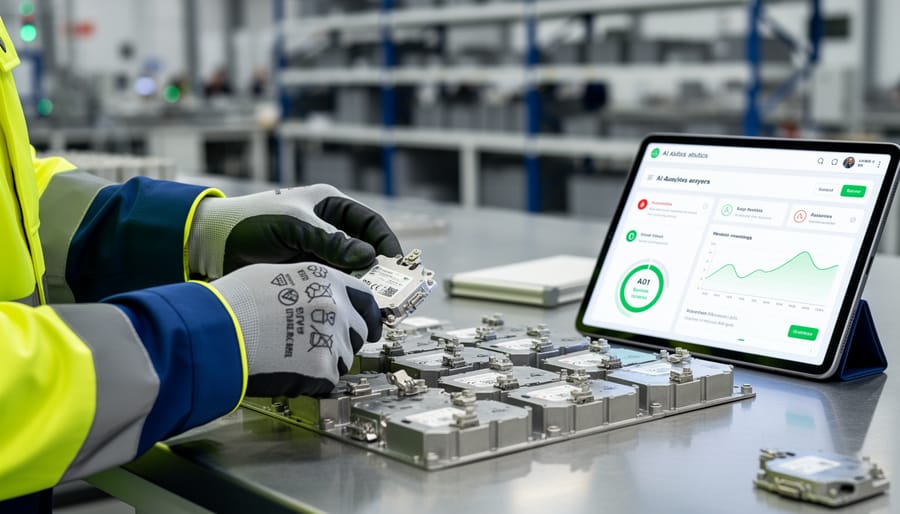
Battery safety analytics starts with comprehensive data gathering through three primary sensor categories embedded throughout battery systems. Thermal sensors track temperature gradients across individual cells and modules, identifying hotspots that signal internal resistance issues or thermal runaway precursors. Electrical sensors measure voltage, current, and impedance characteristics in real time, detecting micro-variations that indicate deteriorating cell health or electrical faults developing within packs. Chemical sensors monitor electrolyte conditions and gas emissions, particularly hydrogen fluoride and other compounds released during early-stage degradation.
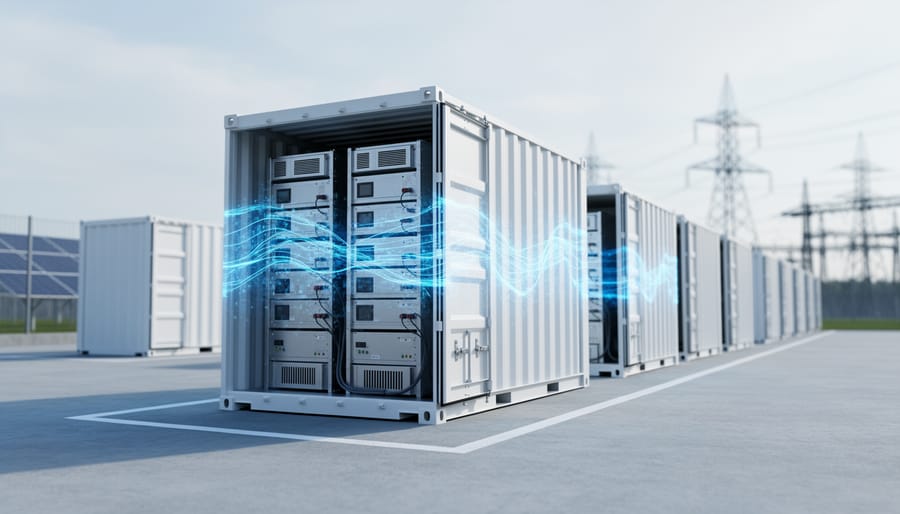
In grid-scale storage facilities, these sensors form dense networks across hundreds or thousands of cells, feeding data to central collection hubs at millisecond intervals. The architecture typically uses tiered aggregation: cell-level sensors report to module controllers, which consolidate streams for rack-level processors, ultimately routing aggregated data to facility-wide analytics platforms. Electric vehicle fleets present different challenges, requiring wireless transmission from moving assets to cloud endpoints where fleet-wide patterns emerge across geographically dispersed batteries.
Modern systems generate terabytes of operational data monthly, creating the statistical foundation AI models need to distinguish normal operating variance from genuine safety anomalies worth flagging.
Machine Learning Models and Pattern Recognition
The machine learning models powering battery safety systems rely on supervised learning techniques trained against vast datasets of battery failure cases. Neural networks excel at detecting nonlinear relationships between seemingly unrelated parameters, a gradual voltage inconsistency combined with minor temperature fluctuations that together signal impending thermal runaway. Random forest algorithms handle the complexity by evaluating hundreds of decision trees simultaneously, each analyzing different combinations of sensor readings to vote on risk probability.
Support vector machines prove particularly effective at distinguishing normal operational variance from true anomalies in high-dimensional data. They create decision boundaries that separate safe operating conditions from dangerous ones, learning where those boundaries exist through exposure to thousands of charge-discharge cycles across different battery chemistries and environmental conditions.
The training process feeds these models historical data from batteries that eventually failed, teaching them to recognize the subtle early-warning patterns that emerged weeks or months before catastrophic events. A critical advantage over human operators lies in the models’ ability to simultaneously track correlations across dozens of variables, relationships that remain invisible when examining individual metrics in isolation. As models encounter more real-world battery behavior, their accuracy improves, refining their understanding of which signatures reliably predict specific failure modes versus harmless operational variations.
Real-Time Monitoring and Response
Once trained and deployed, AI safety systems monitor battery arrays without pause, processing data streams every few seconds or even milliseconds depending on the application. When sensor readings deviate from expected patterns, a cell heating faster than neighbors, voltage dropping irregularly, or impedance shifting unexpectedly, machine learning models flag the anomaly immediately and assign a risk score.
Most platforms operate on tiered alert systems. Minor deviations trigger notifications to operations staff for investigation. Moderate risks generate automated work orders for maintenance teams. Critical threats activate emergency protocols: shutting down affected modules, rerouting power flows, or engaging cooling systems. Some advanced deployments grant AI limited autonomous authority to isolate compromised cells before operators can respond, cutting reaction time from minutes to seconds.
This continuous oversight creates a safety net that human monitoring alone cannot match, particularly in facilities managing thousands of battery cells across multiple enclosures.
Core Components of AI-Driven Battery Safety Platforms
Commercial AI battery safety platforms consist of four interconnected layers that work in tandem to monitor, analyze, and protect battery assets. Each component handles specific functions while feeding data and insights to the others, creating a continuous safety loop that operates 24/7 across distributed battery installations.
At the foundation sits the battery management system (BMS)which interfaces directly with battery hardware through embedded sensors. Modern BMS units measure cell-level voltage, current, temperature, and state of charge at millisecond intervals, transmitting this raw data stream to the analytics layer. The BMS also executes immediate protective actions, disconnecting cells that exceed safe temperature thresholds or halting charge cycles when voltage anomalies appear, functioning as the first line of defense before AI analysis even begins.
The AI analytics engine receives the BMS data stream and applies machine learning models trained on historical performance patterns and failure signatures. This component distinguishes normal operational variations from genuine safety concerns, identifying subtle degradation patterns that unfold over weeks rather than seconds. Advanced engines run multiple algorithms simultaneously, one watching for thermal runaway precursors, another tracking capacity fade rates, a third monitoring internal resistance changes, and correlate findings across the entire battery array to detect systemic issues.
Essential platform components include:
- Cloud or edge computing infrastructure that processes terabytes of sensor data and scales with fleet size
- Predictive maintenance modules that forecast component lifespan and schedule interventions before failures occur
- Alert management systems that prioritize notifications by severity and route them to appropriate personnel
- Dashboards and visualization tools that translate complex analytics into actionable operator insights
- Integration APIs that connect with existing facility management, SCADA, and enterprise resource planning systems
The predictive maintenance module translates AI findings into specific operational recommendations: when to inspect particular battery racks, which cells need replacement, whether operating parameters should be adjusted. It weighs the probability of failure against operational constraints like energy demand schedules and maintenance crew availability, optimizing both safety and uptime.
User interfaces close the loop by presenting operators with clear, prioritized information. A well-designed dashboard shows facility-wide health status at a glance while allowing drill-down into individual battery strings when anomalies surface. Mobile apps ensure critical alerts reach decision-makers regardless of location, with enough context to determine whether immediate action is warranted or if an issue can wait until the next scheduled maintenance window.
Applications Across the Renewable Energy Sector
Grid-Scale Energy Storage Facilities
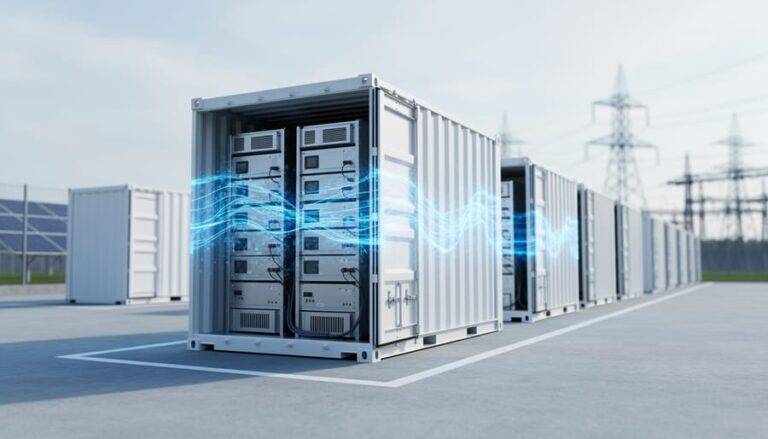
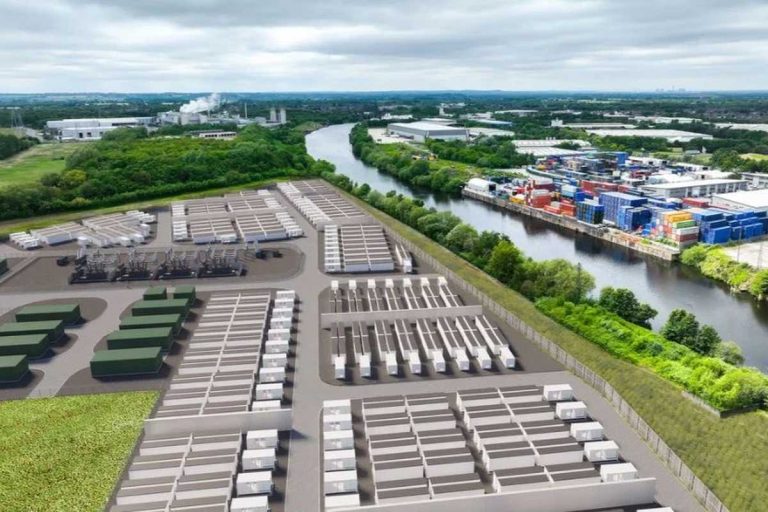
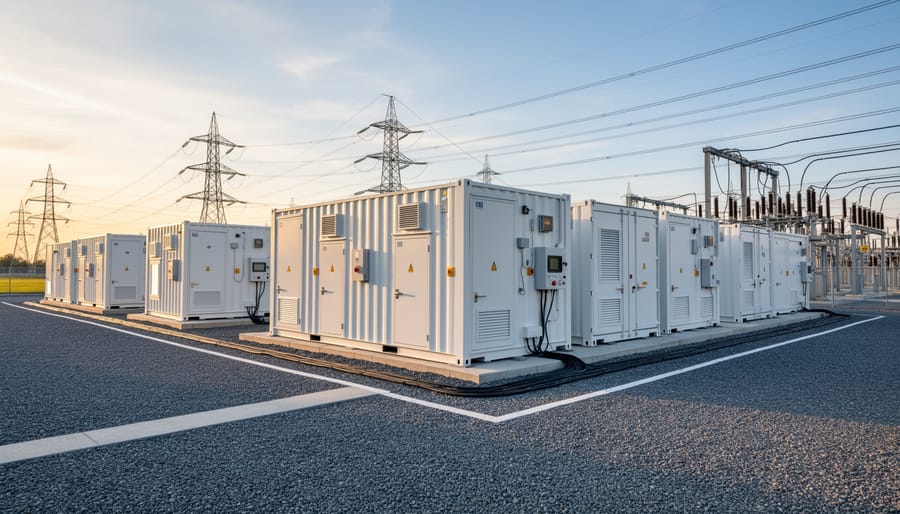
Grid-scale battery installations present the highest-stakes environment for AI safety analytics. A single thermal runaway event in a facility housing tens of thousands of lithium-ion cells can trigger catastrophic cascading failures, destroying millions of dollars in equipment and forcing grid operators to scramble for replacement capacity during peak demand periods.
AI systems deployed at these sites continuously monitor voltage differentials, temperature gradients, and state-of-charge patterns across massive battery arrays. When monitoring 50,000+ individual cells, machine learning algorithms can detect subtle anomalies, a cell cluster warming 2°C faster than predicted models suggest, or micro-variations in discharge curves, that would escape human observation until they became critical incidents.
These platforms address the same fundamental challenge renewable energy operators face with other infrastructure: identifying emerging quality issues before they escalate into forced outages. Advanced systems can automatically isolate compromised battery modules, reroute power flows to healthy sections, and maintain grid commitments while maintenance teams respond to alerts. For utility operators managing 100+ MW storage facilities, this capability transforms battery safety from reactive firefighting into predictable, scheduled maintenance aligned with grid demand cycles.
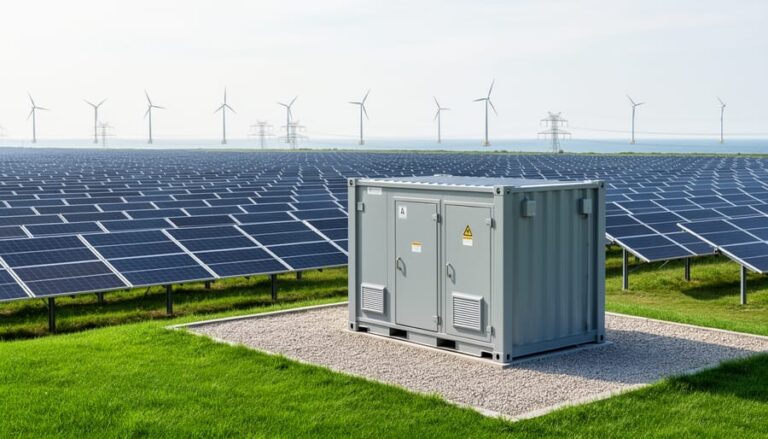
Commercial Solar-Plus-Storage Systems
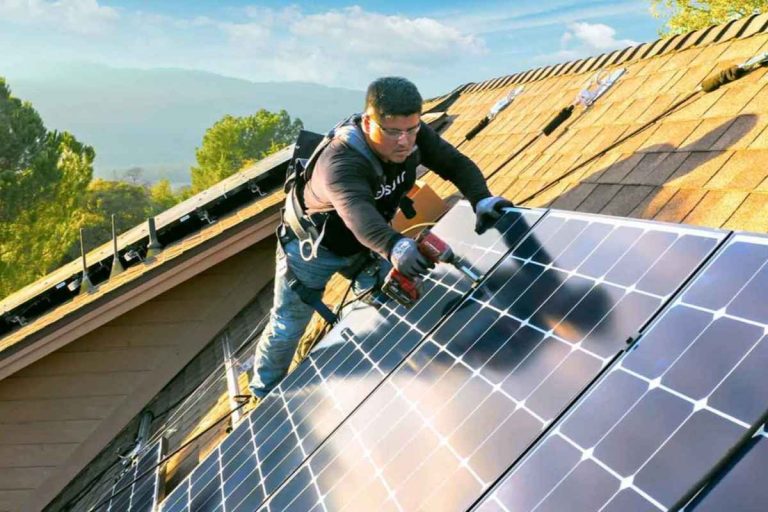
Commercial solar-plus-storage installations present unique safety challenges that differentiate them from utility-scale facilities. These systems typically operate in occupied buildings, warehouses, office complexes, manufacturing plants, where battery failures carry direct human safety implications alongside operational and financial risks.
AI analytics addresses the distributed nature of these deployments by monitoring battery arrays that may be roof-mounted, housed in mechanical rooms, or integrated into parking structures. The technology tracks charge-discharge patterns influenced by solar generation variability and building load fluctuations, identifying stress conditions that accelerate degradation. Machine learning models trained on commercial building energy profiles can distinguish between normal operational variation and anomalous behavior indicating developing faults.
Microgrid configurations add complexity. When systems island from the main grid during outages or peak demand periods, batteries experience rapid state-of-charge transitions. AI platforms monitor these transient events, flagging combinations of temperature spikes and voltage irregularities that suggest cell imbalance or thermal runaway precursors. For facility managers without specialized battery expertise, automated alerts translate complex electrochemical data into actionable maintenance recommendations, preventing safety incidents while maintaining the economic value proposition of solar-plus-storage investments.
Electric Vehicle Fleet Management
Fleet operators managing dozens or hundreds of electric vehicles face a safety challenge that scales exponentially with fleet size. A single battery degradation issue can cascade across multiple vehicles if not caught early, risking driver safety and creating expensive downtime.
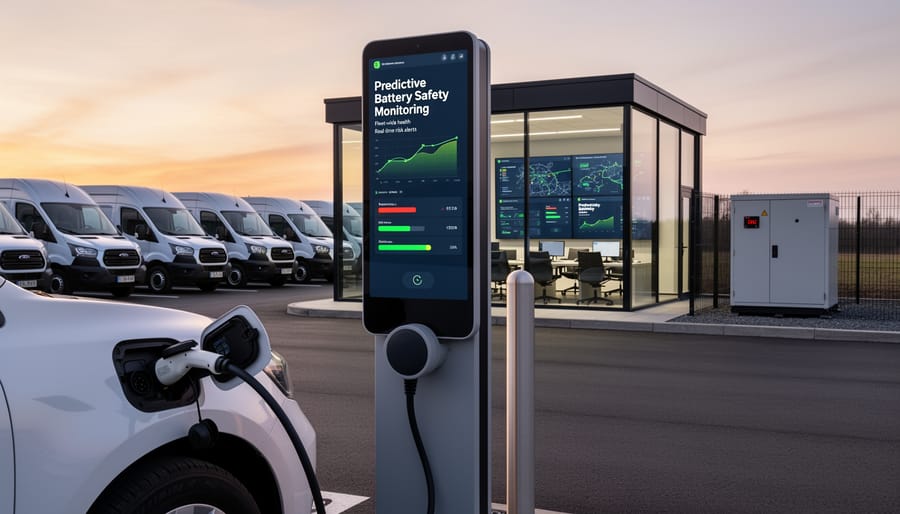
AI battery safety analytics gives fleet managers a centralized dashboard to monitor health metrics across their entire vehicle population simultaneously. The systems track charge-discharge patterns, thermal behavior during fast charging, and performance degradation curves for individual battery packs. When algorithms detect abnormal cell voltage drift or accelerated capacity fade in a specific vehicle, they generate maintenance tickets before the battery reaches a critical failure threshold.
This predictive approach shifts maintenance from reactive to scheduled. Instead of waiting for a battery warning light or thermal event, operators pull vehicles for inspection based on actual degradation data. Some platforms even correlate driving behavior with battery stress, identifying which routes or driver habits accelerate wear.
The lifespan benefit is substantial: batteries kept within optimal operating windows through AI-guided maintenance can deliver 15-20% more useful cycles before replacement. For commercial fleets where battery packs represent 30-40% of total vehicle cost, that extended service life directly improves return on investment while reducing the risk of roadside failures.
Market Insights: Adoption Drivers and Industry Trends
The renewable energy storage market witnessed a sharp pivot toward AI safety systems between 2023 and 2026, driven less by technology enthusiasm than by harsh operational realities. A series of high-profile battery fires at utility-scale facilities, including a 2023 incident that shut down a 250 MW installation in California for eight months, forced insurers to reassess risk models and regulators to demand tighter safety protocols. Companies now face premium increases of 15-30% on storage projects lacking advanced monitoring, according to industry underwriters, while jurisdictions from Massachusetts to Australia have introduced guidelines requiring real-time anomaly detection for installations above certain capacity thresholds. Safe installation and response protocols have become baseline expectations rather than competitive advantages.
Beyond regulatory compliance, the economics tell a compelling story. Battery manufacturers and facility operators report that predictive safety analytics reduce unplanned downtime by 40-60%, translating directly to revenue protection on grid-services contracts where availability penalties can reach $10,000 per day. Total cost of ownership calculations now routinely show that AI monitoring platforms pay for themselves within 18-24 months through prevented catastrophic failures alone, before factoring in extended cell lifespan from optimized charging patterns and reduced insurance premiums. One European energy storage developer disclosed that AI-driven maintenance scheduling cut their operational costs by €2.3 million annually across a 500 MWh portfolio.
Investment patterns reflect this maturation. Venture funding for battery safety AI platforms grew 180% between 2024 and 2026, with strategic investments coming from major battery manufacturers hedging against warranty exposure and utility companies protecting grid-critical assets. The same market drivers accelerating solar growth ambitious renewable targets and falling hardware costs, are also multiplying the number of battery installations requiring safety oversight, creating a compounding demand for proven monitoring solutions rather than experimental approaches.
Case Study: AI Safety Analytics in Practice
A major solar developer operating 850 MW of storage across the southwestern United States implemented AI safety analytics in Q2 2024 after experiencing three thermal events that collectively cost $4.2 million in equipment replacement and lost revenue. Before deployment, their safety protocol relied on manual BMS threshold alerts and weekly visual inspections, industry standard practice that proved insufficient as their portfolio scaled.
Baseline conditions showed an average of 1.8 safety incidents per quarter requiring emergency shutdowns, with mean time to detection hovering around 47 minutes from initial anomaly to human intervention. Unplanned maintenance consumed 6% of operational hours annually, and insurance premiums reflected the sector’s emerging risk profile.
The integration process spanned four months. Engineers installed additional temperature sensors at the module level (existing infrastructure only monitored at rack level) and deployed edge computing nodes to process data locally before cloud aggregation. The AI system ingested 18 months of historical operational data, including the forensic analysis of previous failures, to train its anomaly detection models. Initial calibration produced a 22% false positive rate, which operators refined to 3% through supervised learning adjustments over the first six weeks of live operation.
Quantified outcomes through December 2025 demonstrated clear ROI. The system identified 14 pre-failure conditions that traditional monitoring would have missed, including a developing short circuit flagged 72 hours before projected thermal runaway and a cooling system malfunction detected through subtle temperature pattern deviations. These interventions alone prevented an estimated $6.8 million in damages and avoided 340 hours of forced downtime.
Maintenance costs dropped 34% as the platform shifted operations from reactive repairs to scheduled interventions during low-demand periods. Battery asset lifespan projections improved by 18 months due to optimized charge management that reduced stress cycles. The facility now operates at 98.7% uptime compared to 94.1% pre-implementation.
The most significant lesson: AI systems prevent failures humans cannot see coming, but they require clean data infrastructure and operator trust built through transparent decision-making. False positives in early deployment tested that trust, making calibration transparency essential for long-term adoption.
Common Questions About AI and Battery Safety
Renewable energy professionals evaluating AI battery safety systems consistently raise practical concerns about implementation realities. These questions reflect genuine operational constraints and risk calculations that decision-makers must address before committing resources.
How accurate are AI safety predictions compared to traditional monitoring?
Modern AI systems typically achieve 85-95% accuracy in identifying pre-failure conditions, significantly outperforming rule-based threshold alerts which generate high false-positive rates. The technology excels at detecting subtle pattern combinations that manual oversight misses.
Can AI safety analytics integrate with our existing battery management infrastructure?
Most platforms are designed for retrofit compatibility, connecting to standard BMS protocols through APIs or middleware layers. Implementation typically requires firmware updates rather than hardware replacement, though legacy systems may need additional sensor installations.
What’s a realistic timeline from contract signing to operational deployment?
Grid-scale installations generally require 3-6 months for sensor integration, model training on site-specific data, and validation testing. Smaller commercial systems can achieve operational status in 6-12 weeks once baseline data collection begins.
Does AI eliminate the need for human safety oversight?
No. AI functions as a decision-support tool that amplifies human expertise rather than replacing it, trained operators remain essential for interpreting complex alerts, approving critical interventions, and managing edge cases the models haven’t encountered.
Data privacy concerns center on whether battery performance information could reveal commercially sensitive operational patterns or customer usage data. Reputable vendors implement on-premises processing options and anonymization protocols that prevent individual facility identification while still enabling model improvements across their customer base. The technology’s effectiveness hinges on balancing automated responsiveness with appropriate human judgment in high-stakes scenarios.
AI battery safety analytics has transitioned from a promising innovation to essential infrastructure as renewable energy storage deployments reach unprecedented scale. What began as experimental monitoring systems in research labs now protects billions of dollars in battery assets across utility grids, commercial facilities, and vehicle fleets worldwide.
The technology delivers value on two critical fronts. First, it safeguards capital investments by catching battery degradation and safety risks before they escalate into catastrophic failures, reducing insurance costs and extending asset lifespan. Second, it builds the public trust necessary for renewable energy’s continued expansion. Every prevented thermal event strengthens the case for battery storage as a reliable grid solution rather than a liability.
The systems we’ve examined aren’t static. Machine learning models continue improving as they analyze more operational data, recognizing increasingly subtle failure patterns. Integration with broader energy management platforms is becoming standard rather than exceptional, enabling safety analytics to inform not just maintenance schedules but also trading strategies and grid services.
For renewable energy professionals, the question isn’t whether to implement AI safety analytics but how quickly existing deployments can be retrofitted and new projects designed with these capabilities from the ground up. The technology has proven itself; the challenge now is deployment at the pace the energy transition demands.